Showing posts with label sights. Show all posts

Friday, 22 August 2014

China Part 4: Tianfu, Tinder and Tea

Last time I posted about my mega weekend in brilliant Beijing, but in doing so, I missed out one or two things which happened before that, so I’ll quickly write about that before I go on to week 3.

Two days before I flew to Beijing, a group of us headed back to Tianfu Square (which I wrote about last time) for the Water Show…

“Every evening at dusk, as well as at noontime, an elaborate water show, synchronized to music, bursts out from the square’s fountains and attracts crowds of people during the spring and summer.” (http://www.chengduliving.com/guide-to-chengdu/sights/tianfu-square/) 

Now don’t get me wrong, the fountains were lovely, but you are talking to a person who’d been to the water show at Versailles about three weeks prior, a show which set such impossibly high standards that I’ll probably always be cold hearted and unimpressed at every other fountain show. (Not really. But Versailles was very fresh in my memory). 


Anyway, what was lovely about this was the atmosphere. Crowds of people were gathered, and there were load of little kids running around twirling pretty ribbons on sticks.

And being a big kid myself, of course I had to have my own one.

So me and the others joined the little Chinese kids mucking about in the square, having a good laugh twirling our own pretty ribbons, and attracting, at one point, quite a large audience, which was a bit embarrassing and very amusing at the same time. I think I mentioned when I wrote about People’s Park that people stopped us to take photos – westerners seemed to be a bit of a novelty (at least twice that week I found myself stood by two groups of girls who kept looking at me and bursting into giggles whenever I looked back at them, which was a bit uncomfortable). Anyway, I dread to think how many people took photos of us that night in Tianfu Square.

It was fun, anyway :)


If you read my last post about Beijing, you’ll also know that the whole weekend we were struggling with the heat. Well, we arrived back from Beijing late on the Sunday night and I had to take the Monday off because I was more dehydrated than I think I’d ever been and was feeling extremely rubbish as a result. So the Monday became a bit of a write off, really, as did a lot of that week for one reason or another, although I did have fajitas!

I mention this as a highlight of my week mainly because it was around this point that I realised that there is such a thing as too much Chinese food. Western food is not exactly in abundance out there, and what there was tended not to be great. And so, every day for nigh on three weeks I’d been eating noodles, rice, dumplings, more noodles, more rice, and more dumplings. Then a few more noodles, then some more rice, and then some more dumplings again. It was all delicious, of course, but...

Chinese Proverb*: Two Tons of noodles bring man great fortune
*This may or may not be made up.

You get the picture.

Now I’m home, I’m torn between not wanting to eat Chinese again for some considerable time and wanting to show off my newly found chopstick skills to my parents. I think the former will win out, but who knows?

On Friday night, the PA team had a social at KTV. Now, I don’t know if I’ve mentioned this or not, but the Chinese love karaoke. They love it. When Jane and I went over to People’s Park that week, there were karaoke stations set up along pathways, and every five metres there was someone else singing their hearts out. KTV is a dedicated place for this. Groups of people go in and you can hire a room to sing in with your group – no strangers to act as an audience.

I should also mention that I am no great fan of karaoke, and categorically swore before I left for China that I would not be drawn into it. Nu-uh; no way José.

I could hear my parents and my brother laughing hysterically from thousands of miles away.

Still, it was actually quite fun - it quite quickly descended into a lot of loud group singing, of which I have some hysterical and very embarrassing videos tucked away on my iPhone, and we all had a laugh, and that’s the main thing, really (although, if any of my friends are reading this, don’t expect me to give in and go to karaoke with you any time soon. It’s still not my cup of tea). Although, it did make me realise how much I appreciate the smoking ban back home. My clothes were reeking of smoke by the end of the night.


After that, we all went out to a bar for some more drinks, and then to a club called Muse (which was much flashier than any club I’ve been to back home) where not a lot of people seemed to be dancing. It fell to the western contingent to fly the flag, and so we clambered up on the stage, danced a lot, probably got stared at a lot, got invited over by some man for loads of free drinks, danced some more, had a really good time, and then finally stumbled in about 4am, which was a shame in a way, since it meant I didn’t wake up until embarrassingly late and wasted most of my Saturday.

The weekends were the best parts of my time in China, because as valuable as an internship is, who wants to go all the way to China to sit inside an office all day? I wanted to explore *whines*.

So, when we all regained consciousness, a few of us summoned up some energy and headed over to Wenshu Monastery, which is the best-preserved Buddhist temple in Chengdu. I’d tell you when it was built, except that I found three different websites telling me that it was built in three different dynasties, and so I have no clue.


Still, it was very large, and very interesting to walk around, looking at all the statues of Buddha, the flowers placed in front of individual statues, and people lighting incense and placing them in large cauldrons or something similar.

It was very traditional and tourist site or not, really made me think of real China.


Outside the monastery, there were a few local shops and stalls, and a local performer... 


This was also where Noémie and Michela also had an unfortunate (but quite entertaining) experience with durian, which is a fruit very common in Asia, particularly, I’m told, in Thailand. They’re everywhere, so this wasn’t the first time I’d come into contact with it – you can’t miss it, really, as it smells absolutely revolting. I simply cannot emphasise enough how bad this thing reeks - you don’t even need to crack the shell open for this fruit to smell extremely strongly, and I don’t exaggerate when I say it could set off my gag reflex. Jane didn’t like the smell either, and she told me that it tastes exactly how it smells, so I wasn’t about to go trying it. But Bryan, another volunteer from Macau, was with us, and he convinced them that it was lovely and that they really should try it…

Mean trick. They tried it, they hated it, and their faces were absolutely priceless. It was hysterical.


On Sunday, we headed back to People’s Park, where we stumbled across something very, very bizarre.

Picture the scene. You’re stood in the middle of a very large and noisy park. Along one pathway, there are lots of older Chinese people, both men and women, stood next to large easels on which big posters have been set up, full of Chinese characters and numbers, and sometimes photos.

These posters are listing all the personal details of the children/grandchildren of these old folk. And I mean all the personal details.

Age, Height, Weight, Degree, Job, Do they drive a car? What is their salary?


And then people walk around reviewing these posters, and they will do some sums to see if the numbers match up – if they’re lucky according to Chinese superstition, and the like – to see if two people are an acceptable pair, hoping to get the subjects of these posters married off.

It’s a dating service run by your mum, essentially.

Oh, China, you’re so wonderfully weird.

Heading out of TinderZone, as I have baptised it, we walked past a group of men painting Chinese characters on the floor with water, which was oddly fascinating to watch.


Really, when I’m talking about China – and People’s Park in particular - I think my only option is to upload the odd video that I took. Everything is so different, and to me, who before now had only ever travelled in the West, every new little thing like this was a constant source of fascination to me. In any case, I really think that China is not a place to be described, it is a place to be seen, and so my dodgy videoing skills shall have to suffice in the meantime.

We also made sure to have some tea in a teahouse that me a Noémie found the first time we went to the park. I had Chrysanthemum Flower tea, which I didn’t think I’d like, but which was actually surprisingly nice, which might be down to the sheer amount of sugar that came in the bottom of the glass. Some of the other, more traditional teas looked somewhat suspect to me though, and I’m not so sure I would have liked those, although I’m not in a position to judge since I didn’t actually try them.


We also went to the Wide and Narrow Alleys, two old fashioned streets in Chengdu which have lots of traditional teahouses and places to eat. Last, but most definitely not least, I also went to see the Pandas (yay!) but, to do them justice, I’ll write about them in the next blog post (which will also be the last one on China).

By the end of the weekend I only had 5 days of internship and 9 full days in China left. Those first three weeks went extremely quickly, which I’ll admit, I was quite happy about. I’ve spent a lot of time away from the UK and from home this year and despite the fact that I was having the time of my life; I was also rapidly reaching my limit, and the idea of spending more than 5 days at home before rushing off somewhere else again was looking increasingly attractive.

Next Time – China part the last (part 5): Pandas, Poets and Planes

Vicky xx

Sunday, 17 August 2014

China Part 3: Hostels and Hiking

When my trip to China was being planned, travelling in China was not on my to-do list. There were just too many practical issues. I wouldn’t have enough time; I wouldn’t have enough money, blah blah blah. I would just stay in Chengdu, where it wasn’t exactly like I would be bored, and one day in the long distant future when I’m not a poor student any more but (hopefully) a career money with some cash in the bank, I’d return to China and explore properly later.

But then I got to China, and I got jealous of everybody talking about all the travelling they’d been doing, and someone said, “Hey, let’s go to Beijing for a weekend!”

I thought about it.

For all of about two milliseconds.

Carpe Diem, as they say.

So ten days after I landed in China, I found myself back on a plane and Beijing bound. We managed to book tickets on the 07:30 Sichuan Airlines flight out of Chengdu and were in Beijing nice and early.

We stayed at Sanlitun Hostel, in the Chaoyang district, which we found on hostelworld.com. It was perfect for what we needed; not expensive, and it had a small restaurant/bar where we could grab breakfast or a drink in the evenings, and it was only 20 minutes or so away from Tiananmen Square and the like, which was where we headed first.


We started out in Tiananmen Square, which aside from being extremely large (it’s the largest public square in the world, and can hold over 1 million people) is perfectly unassuming, and it’s hard to relate the square as I saw it to the famous tank man picture taken during the infamous events of 1989.

It’s home to the Chairman Mao Memorial Hall, the National Museum of China (or something like that, I forget exactly what it was called) and a large monument in the centre which Google tells me is the Monument to the People’s Heroes.


It’s also roughly where you go to get into the Forbidden City, which was the imperial palace for the emperors of the Ming and Qing dynasties. It was listed by UNESCO as a world heritage site in 1987, and you can see why. It is extremely impressive. The buildings are huge and ornate, and the gardens were beautiful. You can’t really go to Beijing and not visit.


That said, there are drawbacks to visiting. The Forbidden City is also the world’s largest palace complex (the Chinese like to be the biggest, apparently!).

Seriously. Once we got inside, it seemed to go on and on and on and on forever and ever and ever. I thought I was going to die there, old and grey, if I didn’t melt first. (Not really). There are so many courtyards, one after the other, and after a while, everything began to look the same and all we wanted to do was find the exit, which took a while. Also, even though it was a weekday, we are slap bang in the middle of peak season, and the crowds were pretty bad.

So – if you ever go, here’s my advice. Don’t go in the middle of summer, when it’s at its most boiling, and make sure you get an audio guide or something, so you actually know what you’re looking at (rookie mistake, I know, but there we have it).

We also had a bit of a weird food moment in the Forbidden City, when I was dared to buy a pea flavoured ice cream. I shouldn’t need to tell you that it was absolutely vile, and went in the bin pretty quickly. (Also, out of curiosity, I looked up #peaicecream instagram later on, and apparently if I had actually tried to eat the thing, I would have found actual peas on the inside. Gross)


Luckily, food for the rest of the weekend was perfectly fine. That night we went to Gui Jie and found a restaurant to have some proper Beijing Peking Duck, which (when it arrived – we were sat waiting for it for ages) was tres bien.

We essentially organised our Saturday around the tours that were advertised in the lobby of our hostel, so we started the day by heading about 70km northeast of Beijing on the coach, hopping on to a chair lift and up a very large mountain to see the Mutianyu section of the Great Wall of China.


I don’t know what was more impressive, really: the fact that this wall, crawling over mountains and through thick trees, was just so massive – it’s quite the commanding site – or the fact that something so massive and it was built by hand. On said mountains, through said thick trees, and from the middle of the 6th century, no less.


Anyway, once we got to the top and took a few lots of photos, we decided to hike towards one of the many watch towers on this stretch of the wall, and the last part open in that direction before the dilapidated section, and then head back and do the other direction after that.
This proved to be a bit optimistic.
The mid 6th century Chinese builders did not build the wall with 21st century tourists in mind, and in places the stairs up to this watch tower were so steep that the staircase was essentially vertical. Rock climbing gloves would not have gone amiss (okay, I exaggerate, but seriously, climbing the wall took effort. When they say that you go hiking on the wall, they mean it, it’s no gentle stroll!). It also did not help that on the wall; the temperature was at least 40°C, with little to no cloud cover and little to no breeze.
Anyway, having sweated out at least half my body weight, we got to the top (yay!) where there was a little man selling bottles of water. He wanted ¥20 for one, which was a bit steep when we’d been paying about ¥3 in Beijing, so I didn’t buy one. Looking back, this was exceptionally stupid, given just how hot it was, and given that the man only wanted what was essentially £2, and this was probably one of the reasons why I ended up severely dehydrated by the end of the weekend, but perhaps I can blame said dehydration for my pig-headedness (Can’t I?)
Still, the wall was very impressive and offered some seriously brilliant views of the valleys around the bottom of the mountains, and we really couldn’t have gone to Beijing without going, could we?

Going back down to the bottom of the mountain, we took a slightly more interesting route than we had on the way up. We tobogganed down, which was quite fun (if slightly alarming on the sharper corners), and then went to a restaurant for our lunch, which was included in the amount we’d paid for the tour, and which turned out to be a lot bigger that I’d been expecting. We definitely got our money’s worth :)
When we got back to Beijing, we showered up and grabbed dinner at the hostel before heading a few minutes down the road for a show put on by the China National Acrobatic Troupe, which was also really good – there was a contortionist, and a juggler, some seriously cool stuff on a tightrope and loads of other stuff. You can see why the Chinese win so many medals in gymnastics, with the way this lot were jumping around. They must put so many hours of training in to do what they do – would you want to climb onto a tower of people balanced on a moving bike? I wouldn’t!


After the acrobatics show finished, we got back on the subway and went to Wanfujing’s snack street. It’s packed with food stalls which served some seriously strange street food – live scorpions on sticks, anyone? No? How about starfish? Still, it was actually really fun to meander around and look at the good and the stranger elements of Beijing, and we all did a bit of souvenir shopping.


Next morning, we decided to head back to Tiananmen Square and go to Mao’s Mausoleum, which is worth a visit if taking a few hours out of your day to see an embalmed communist leader is your thing. This was a simple enough plan, except that when we got to Qianmen station, we emerged into what can only be described as chaos. When we had been to Tiananmen Square on Friday, visiting hours at the Mausoleum were already over, and it was quite quiet. We wandered up to the Forbidden City with no problems.

Not so this time.

People were queuing up to get through security in droves. There were thousands and thousands of people, none of whom knew the definition of queuing, all of whom knew the definition of queue jumping, all of whom were happy to yell and scream and elbow the people next to them to get through quicker. Similar behaviour when we actually got into the square; similar behaviour when we actually got into the queue.

Then the realisation that we weren’t actually allowed to take any bags into the mausoleum. Helpfully, there were no signs anywhere to point this out, and the City Guide by TimeOut Beijing, which we’d been relying on, also very helpfully neglected to mention this. So (once we’d eventually established what the problem was and where I had to go to solve it) I had to dip out of the queue, head to the opposite side of the square to deposit our bags, and then wrestle through queues and security again to try and get back into the queue, which was exhausting. And then we spent an hour and a half queuing to get in (under relentless sunshine and with no water, seeing as we weren’t allowed our bags or anything really in the way of possessions, which just led to us feeling simply awful later).

It was actually this visit to the Mausoleum where I really saw for the first time that, for all its friendly façade and influx of capitalist brands, China is after all a communist country. When a big figure dies in the UK, or wherever, there’s obviously some public mourning – think Princess Diana, and the like – but it goes beyond that in China. It’s not just your average respect for the dead: there is a personality cult surrounding Chairman Mao (I mean, there’s a giant portrait of him adorning the entrance to the Forbidden City, which predates the communist regime by thousands and thousands and thousands of years!)

When we finally got close to the Mausoleum, people were buying yellow flowers, which, when we got inside, they laid in front of a giant statue of Mao, usually bowing at him several times. And then of course, there’s the fact that they embalmed him in the first place, for people to go and gawk at.

It’s an interesting phenomena, particularly when you take this in the context of a simple google search - the Cultural Revolution, or the famine caused by the 'Great Leap Forward', which killed 30 million Chinese peasants, or thereabouts, in between 1959 and 1962... I don't claim to be particularly knowledgeable about Mao, and I'm sure he did good things for China, but there is a reason he has his critics. 

It’s all very odd, and slightly uncomfortable.

Anyway, after this brief interlude (we were only actually in the mausoleum for about five minutes, after all that), we went and got our bags, and some lunch, and headed over to the Temple of Heaven, which is another complex of China’s ancient sacrificial buildings (the Hall of Prayer for Good Harvest is the most famous part).


It’s also yet another UNESCO World Heritage site – China has 47 of these, second most in the world behind Italy, who has 50. I managed to visit a fair few of them in the short time I had.

By this point, though, I think the heat just got too much. It was extremely hot, we were sweating faster than we could replace the water, we’d done a lot of walking, and although we had time to do at least one more thing if we had wanted to, I think if we’d tried, one or all of us would have ended up with pretty severe dehydration and heatstroke. So we headed back to the hostel to freshen up and hang around in the air conditioning until it was time to head to the airport for our flight back to Chengdu.

Obviously, Beijing is a lot bigger than just the stuff that we saw. There was loads of stuff that we didn’t see, like the Summer Palace, the Ming Tombs and the famous Olympic Park, and that’s just the sights, not the real Beijing. But we just ran out of time, (and I suspect we wouldn’t have been able to summon the energy to do more in any case, it was just so hot).

Still, it was a really good weekend, and I’m so glad that I went and got to see a little bit more of China while I was there. It would have been silly to travel more than 5000 miles to somewhere I am extremely unlikely to be again very soon, and not make the most of it while I could.

I know this was another super long post, but you can’t go somewhere like China and not have a lot to say about it!

Next Time – China part 4: Tianfu, Tinder and Tea

Vicky xx

Thursday, 7 August 2014

China Part 1: Food, Flights and Feeling Foreign

I promised I’d blog it, and here I am. I should mention is that it proved to be rather optimistic to fit a month’s worth of stuff into one post, or even two - I’ve split it all up (and this post is still going to be long and meandering, so I hope it’s readable). There’ll be several instalments before I wind this blog up for good at the end of the month.

So. As you might already know, I spent the last month in Chengdu, China (I got back yesterday). Chengdu is the capital city of the Sichuan province, in Western China, bordering Tibet. Originally, I was supposed to be going to Shanghai, and I was disappointed at first when it was changed to Chengdu. But as someone pointed out to me when I got there, Shanghai is, for all intents and purposes, a very western city, with lots of skyscrapers and western food. The reason a lot of people haven’t heard of Chengdu is because it’s a very liveable city, and not particularly touristy, like Beijing and the like, which means that I got to experience a lot more of real Chinese life and culture than I would if I had been to Shanghai instead. Now I’m back, I’m glad things ended up the way they did.

Who can resist a good 'I'm going travelling, look at me!' photo? Not me, apparently. 

Including the connection in Doha (I flew with Qatar Airways, who I’d recommend. They were actually very good, with lots of legroom and they served edible meals in strange abundance), it was roughly 15 hours to fly from Heathrow to Chengdu, and happily it was not at all stressful. I landed in China at about 3pm on the Tuesday afternoon. My first impressions are a bit vague… it was very humid outside (and continued to be for the rest of the month. But then, it is rainy season). Second – Chinese immigration officers are slightly frightening. Third - the toilet at the airport was just a hole in the floor, much to my dismay. And fourth - the clocks don’t change in China. So one of the first things that I noticed through my jet-lagged haze was that it got dark early. Pitch black, by 9pm, which was very weird for a while.

I got shown my apartment, in the Tongzilin area of Chengdu (where I found out that we were one of few apartments who actually had Wi-Fi. WIN!) By the time I’d been there for 6 hours or so, I’d bought a Chinese simcard (and phone, because idiot here didn’t bring the spare mobile I used in Paris with me), walked around being shown where the metro and the supermarket was (directions which I promptly forgot) nearly got run over and was given a travel card for the metro.

As a short aside, while I’m mentioning the metro - and driving, and transport generally - traffic regulations in China seem to be less 'laws' and more 'guidance'. It got pretty hairy at times, and you had to be very careful when you are crossing the road, even when there is a green man, because apparently the motorcyclists/moped people have apparently universally decided that red lights don't apply to them. Sometimes, I’m fairly sure that they’d happily travel the wrong way up the street. All the public transport is state operated: there is a metro in Chengdu, but it is very limited because it’s about as new as metros can get. There are only two lines operating so far, the youngest of which opened 2 years ago, and I think there are plans to build at least six more by 2020. To get in, though, you have to put your bags through a security scanner. It's like going to the airport every single time, which can get a bit tedious, if I'm honest. 

Anyway, back to business. After all of that, I suddenly realised that I was starving. So a few other volunteers and I went searching for somewhere to eat, and I had my first authentic Chinese meal. I’ve never felt more foreign in my entire life. At least in European countries the letters are familiar, but here, you couldn’t even make an educated guess. We pointed at a few pictures, looked blankly at the waitress who was trying vainly to help and hoped for the best (and luckily, everything turned out to be edible, so that was a win). We ended up with two types of noodles, some rice, two portions of what dumplings and some kind of soup, which you drank out of the bowl. I successfully wrestled my way around the meal with chopsticks (although the next few times I used them after that, I was a total fail, so chopsticks really were a bit hit and miss for me. I’m blaming my left handedness. Never mind the fact that thousands of Chinese people are probably left handed too), and then I discovered the delights of the ¥/£ exchange rate.

Our meal (for 5 people) came to ¥53, or roughly £5.30. A pound each. Seriously! The basic rule of thumb is that if you delete a zero from the Chinese sum, you have the equivalent in pounds. So ¥10 is £1.

And everything is cheeeeaaaaaap.

Later in the week, I took a journey on the Chengdu metro over 6 stops (roughly the distance of, say, Oxford Circus to Liverpool Street on the central line, and it cost me 34 PENCE.)  The day after that, a meal for 11 people cost £30 altogether. A 40 minute journey in a cab cost £4. I kid you not; China is an affordable place indeed - for westerners. I'm under no illusions about how different it is for someone on a Chinese salary and actually had some interesting discussions on the topic during my stay.


Anyway, after that, we went to the supermarket - Carrefour, funnily enough, but nothing like the French version. There’s a distinct lack of croissants for one thing, and the meat counter is very alarming for another. It’s all dumped – no wrapping – in a large fridge, open to the elements (and flies) and people will pick up bits of meat with their bare hands and poke and prod it for a while before deciding that actually, they don’t want it. It smelt terrible. (Needless to say, I didn’t frequent the meat counter). Also, you can buy live fish for food. They hook them out of their tanks in a net and then slam them to the ground to kill them. Charming, no? There were also turtles in similar tanks and I’m really hoping that they didn’t end up with the same fate as the fish!

Meanwhile, the yoghurt aisle had descended into something reminiscent of Romford Market, because there were a lot of people yelling about (presumably) yoghurt into microphones..

I forced myself to stay awake and be sociable that night in an effort to go to bed at a normal hour and make my body clock adjust, but I was super tired for a few days. (Someone told me that it takes a day to recover for every hour of time difference. I haven’t a clue if that’s true or not, but I’m taking that excuse and running with it). And after I did eventually go to sleep, I woke up the next morning stiff as a board. Chinese beds are hard. Like bricks. It didn’t even dip when I sat on it. Anyway, after unpacking and doing all of that kind of thing, I went to a barbecue put on by the Projects Abroad staff.

On the way there, we walked past a park, where there were loads of Chinese people playing with what looked like a large metal spinning top, and to keep it spinning they hit it with a large metal thing - it looked (and sounded!) a little bit like a whip. And there were also loads of Chinese people just dancing - like properly dancing, the waltz or some such thing - around the square to music. It was quite surreal actually. At the BBQ itself I met some of the staff and some other volunteers, and had a go at making my own dumplings (which I was terrible at), and the next day I was shown how to get to my placement (which as I mentioned, I’ll be posting about separately, for purposes of not making this blog post an epic novel).

At the weekend, I had to attend a 'cultural class' - basically a crash course in not mortally offending Chinese manners while I was there and some basic mandarin so I wasn’t completely helpless in every single situation! Unfortunately, I forgot most of it almost immediately – it was very intense. I think the problem was that the teacher tried to feed us way too much information in an hour and a half, so I didn’t have time to commit anything to memory before we moved on.

What else? (I am aware that I’m rambling but you try putting a months worth of happenings into a blog post worth reading!) We decided to have a bit of a gathering in our flat that night, and went to Carrefour to pick up a few things (including Cucumber flavoured crisps, which for the record, are vile) and saw some Tibetan monks casually doing their grocery shopping. Obviously normal – Tibetan monks need food as much as anyone else, but for some reason this struck me as seriously odd. Culture shock, I suppose. In a pleasant contrast to Paris, and home for that matter, everything opens late on the weekends here - properly late. We're talking 23:00 for Carrefour, even on Sundays (I guess, because it's an officially atheist country, although I could be wrong about that.)

Also that weekend, Noemie from my apartment was invited by a colleague to a barbecue. She took us all along, and it was an experience in and of itself.

Now, in the street, it has to be said that some Chinese people can be appallingly rude. Although you could say that of many other nationalities too. And I suppose in all fairness it should be pointed out that there is an exponential culture difference, which apparently extends to what behaviour is appropriate in public (hint: it would be completely frowned upon here). People spit - a lot - they shove, shout and pint, and for young children, everywhere is a public toilet. Seriously - their children do not wear nappies, and they have conveniently placed holes in their trousers so they can go wherever and whenever they please.  Usually on the street - sometimes you'll catch a parent holding their child over a rubbish bin instead, which is marginally better I suppose. Still, I question how they are ever potty trained.

Having said all that, at home, things are different. Their hospitality is second to none (that I've ever experienced, anyway). They mentioned it in our culture talk, but here, I saw the proof. People they invite into their homes are honoured guests. During this barbecue, we offered to help but she wouldn't hear of it, we were constantly plied with food and drink, she spotted my mozzy bites (of which, sadly, there were many) and went dashing off looking for something to put on them, and then when we left, she apologised for not looking after us properly! Anyway, we had a lovely time, played a million rounds of some game that I vaguely remember playing in Drama class at Crofton, and I tried some more authentic Chinese food.

One dish, which I did not try, was chicken feet. It turned up, and although I already knew that the Chinese weren't picky about what part of an animal they eat, I was still a bit like, Oh my god. That is literally feet. Battered feet in a bowl. I'm sure it tastes fine, or they wouldn't eat it. But I just could not bring myself to put a chicken foot in my mouth. Sorry.

Once we made our excuses and left, Noemie and I headed into the main part of Chengdu to have a look around. We started in Tianfu Square, which is a large public square overlooked by a giant statue of Chairman Mao. He has his hand in the air, supposedly waving to the people, but one of the Projects Abroad staff told me that it's a local joke that he's actually just trying to get a taxi and is having no luck haha. 

Give up, Mao! You're not going to get a cab!

Then we walked to People's Park, which is one of the most insane, crazy places I have ever been. How can I explain this? I've never seen anything like it before, and nothing I can say will really give you a decent picture of how nutty this place was, but I’ll give it a shot.

Every pathway, nook and cranny had been filled with makeshift tents, of a sort, erected very close to each other along the pathways, and in each tent people were gambling, dancing, being terrible at karaoke or singing (marginally better than the karaoke crew) and putting on performances for small crowds of people. People would go up to these singers on the stage and give them flowers, presumably plastic ones, which were conveniently placed in buckets at each corner closest to the audience. And because these tents were so close together you only had to walk about a metre in one direction or the other before the tune would change completely… Honestly, it's not something you can really make clear in words alone!


I’m not even really sure that you can tell what it’s like from that montage that I made from the videos on my phone, although on the first clip, you can clearly hear the guy who is singing in the second clip, and in the clip at the end, where people are dancing, you can definitely hear the opera woman who preceded it. Essentially, it’s big, it’s loud, it’s uniquely Chinese and it’s completely and utterly insane.

There are also several teahouses in the park (I'm really not a big fan of Chinese tea but I did have a proper Chinese tea experience before I left) and a really cute boating lake, which my brother said looks a bit like Central Park, and (here is where I show how culturally ignorant I am) loads of classically Chinese... Structures? Shelters? I don't know.  


And also, much to my bemusement, we ended up being a bit of a tourist attraction ourselves. I’ve already mentioned that Chengdu isn’t very touristy, and you don’t really see many westerners around. I was always getting stared at on the metro, and we got stopped several times in the park so that people could take photos of (or with) us.  Which is a bit strange but quite funny, really.

That pretty much sums up my first week in China. It’s a bit rambly, but actually, China is a bit rambly, so maybe that makes sense.

Next time – China part 2: Internships and Intestines

Vicky xx
Tuesday, 24 June 2014

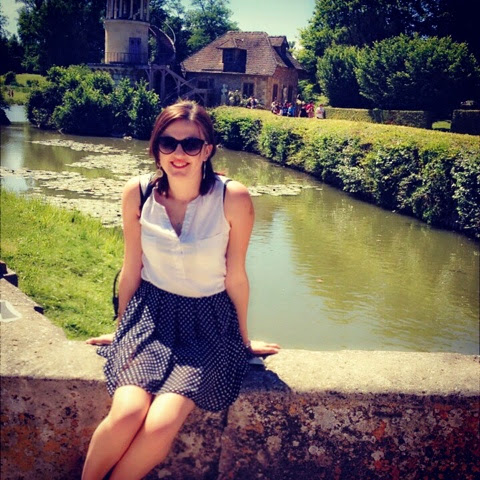
Un weekend des châteaux: #2 - Fontainebleau

As I mentioned in yesterday's post (two in a row! And there'll likely be more this week), one other thing on my bucket list which I have now managed to cross off is the Palace of Fontainebleau, about 55km outside of Paris.

Anne-Marie and I took the transilien from Gare de Lyon (one of the most confusing metro stations I have ever been to, thankyou very much), which took about forty minutes or thereabouts, and then walked from Fontainebleau-Avon to the Château itself, through quite a lot of lovely parkland.


This area is actually home to the Fôret de Fontainebleau, and people come here on droves at the weekends with their bikes to follow the trails. It's home to several endangered European species and used to be a royal hunting park, which I would assume is why the palace was built where it was, essentially as a rather over the top hunting 'lodge'. Although don't quote me on that. It's a bit of a lame description for a château which, along with its park is actually listed as a UNESCO World Heritage Site.


The palace is simpler than Versailles but still very grand. The chapel and the throne room (which used to be the King's bedroom but was converted by Napoleon) are two such examples.


The palace's library is also pretty impressive and held a certain amount of appeal to a bookworm like myself!

Despite it's royal heritage, I actually found myself more interested in the château under Napoleon (Bonaparte). His famous uniform is displayed there (and really, I know it's famous that ol' Boney was very short, but seriously, he was short!) as is the room where he abdicated before he was exiled to Elba in 1814 (from where he later escaped). 

It was an another absolutely boiling day though, and I found myself flagging pretty quickly. The park (and its nice shady trees) ended up being much more appealing to me than the château, interesting though it undoubtedly was. I think I would have appreciated it more if I hadn't been to Versailles just the day before, and I think that at times Anne-Marie and I were thinking more of how much our feet hurt than what was in front of us, but it was a very lovely day!

Vicky xx

Monday, 23 June 2014

Un weekend des châteaux: #1 - Le Palais de Versailles

On Saturday, I finally made it to Versailles, with a week to spare!

Well, it sounds like I was cutting it close, but I've honestly been 'saving up' Versailles if you like, mainly because I thought that it would be better to go and see it in the summer when its beautiful gardens should be at their best, but also because I realised, upon doing some idle googling one day, that the light show happens on Saturdays, starting from yesterday, and yesterday being my very last Saturday in Paris, (I know! *sob*), it was the only day that I could do it.

Me and my friend Anne-Marie headed over to the RER station at Musée d'Orsay earlyish on Saturday morning - but if you're going there, note that you can get there on the same ticket and a lot lot quicker if you get the train from Montparnasse to Versailles-Chantier, which we realised on the way back. The walk from the station to the château is a bit longer but it's worth it.

The Versailles website suggests that on the busiest days you start off on the Gardens and make your way into the Château itself later in the day to avoid the worst of the people traffic, and so that's what we did. 

The gardens themselves are very beautiful, and I think that holding off on a visit until summer paid off very nicely. The flowers were in bloom, the fountains were running, and people were out boating on the Grand Canal, and it gave me a very nice holiday feeling, thankyou very much, as opposed to feeling like I was on 'just' a day trip.


It was also sweltering hot - there was not a cloud in the sky until well after 19:00 and all in all I really think the gardens were at their best. 

A (rather pricey) chocolate ice cream later, and we walked leisurely up the Grand Canal towards the Grand and Petit Trianons, and Marie-Antoinette's hamlet. 

This is where you start to understand why the citizens of France started to get a bit disgruntled with their esteemed Royal Family and start a wee revolt. The Grand Trianon was apparently built so that the King could have a little privacy with which to conduct a love affair. 

An excellent use of the peoples taxes, no?


Anyway, the gardens of the Grand Trianon, again, were what struck me the most, and me and Anne-Marie spent ages taking pictures of them.


Marie-Antoinette's hamlet was something else that made me laugh. Of course the woman who supposedly declared, "let them eat cake!" would play pretend and be 'normal' by ordering an entire mini village to be built in her back garden!

It was very lovely though. I could have spent a couple of hours there alone, meandering around and enjoying the sunshine.


After this, we were getting quite hungry, so we stopped off at a restaurant, whose name currently escapes me, for something to eat. Considering we were sitting in the middle of one of the biggest tourist-traps in the whole of Île de France and beyond, the prices were fairly reasonable - €11 or so for a pizza, €8 for a ham omelette with a salad and bread. The ony thing that was noticeably extortionate was the coke. A medium sized one cost Anne-Marie something on the region of €5.60!

Anyway, hunger satisfied we made our way into the château itself. Truly, you can see why Versailles earned the reputation it did. It is dripping in splendor, nearly everything covered in marble and gold leaf and so on. 

Most famous of all, and for good reason, is the Hall of Mirrors, a long gallery adorned with several mirrors (duh), chandeliers and large windows which make the room bright as anything and very very beautiful. 


If I had one complaint to make about the château, it would be this.

Overcrowding.

The amount of people filtering through the Grands Appartements was, at times, slightly alarming. There were people every which way, the temperature in the room was climbing steadily, there wasn't much in the way of seating for those - I'm thinking here of the elderly and not the lazy - who needed it, and at times it was hard to see any of the room in which we were standing for the throng of bodies. It made it quite hard to appreciate what we were seeing. And this was late in the day when there was supposedly 'less' people traffic.

They need to, in my opinion, introduce a system rather like that which they have running at Buckingham Palace in London, where you pay for a ticket which can only be used within a  certain timeframe, thus staggering out the number of visitors. I understand the need to make money from opening the palace up to the public, I do, but Versailles obviously makes so money in a year that I really wouldn't be all that concerned if I limited the number of people who could go through at once. The gardens are more than big enough and nice enough to keep people entertained in the meantime. 

Anyway, my whinging over and done with, I can carry on to the Royal Serenade, which we also paid to see (largely, I admit, to fill the gap in between the closure of the château and it's gardens and the light show in the evening).

Basically, it consisted of a company of actors in period dress, putting on three mini performances throughout the grand apartments.

First, an opera singer and period instrumentalist - I'm completely ignorant about these things, but if I had to guess, I would say it was a lute or something similar.

Second - and my favourite segment, was a display, set to music, of the rituel d'habillage, or the ritual in which courtiers of the day would dress their King and Queen.


And last, a man playing some kind of instrument that reminded me a lot of bagpipes, but which was actually something else.

Anyway, after this an hour wait in the sunshine saw the gardens being reopened for the evening show. Wandering around the gardens, all of the fountains had been turned on. Some were playing to music, some had strobe lights and dry ice, and some put on seven minute 'displays' which were pretty awesome to watch.


The sunset was spectacular, and right before the sun dipped totally below the horizon, the sky was a bright crimson, which reflected in the Grand Canal made a real sight to behold.


And then, the pinnacle of the night - the fireworks. This was what we'd all been waiting for, really, and it didn't disappoint. I would add pictures, but my phone had died by this point and they're all on my camera (and I currently have no laptop to transfer them to, as I sent it back to the UK with my dad for some much needed repairs).

All told, it was a very nice, if very exhausting day, and I'm glad I managed to cross it off my bucket list. It wasn't the only château I went to this weekend - I visited Fontainebleau on Sunday, but I'll post about that separately. 

Speaking of, today is Monday and I leave this week (!!!!!) so I only have 4 more full days to explore. 

Time flies -

Vicky xx